
Introduction
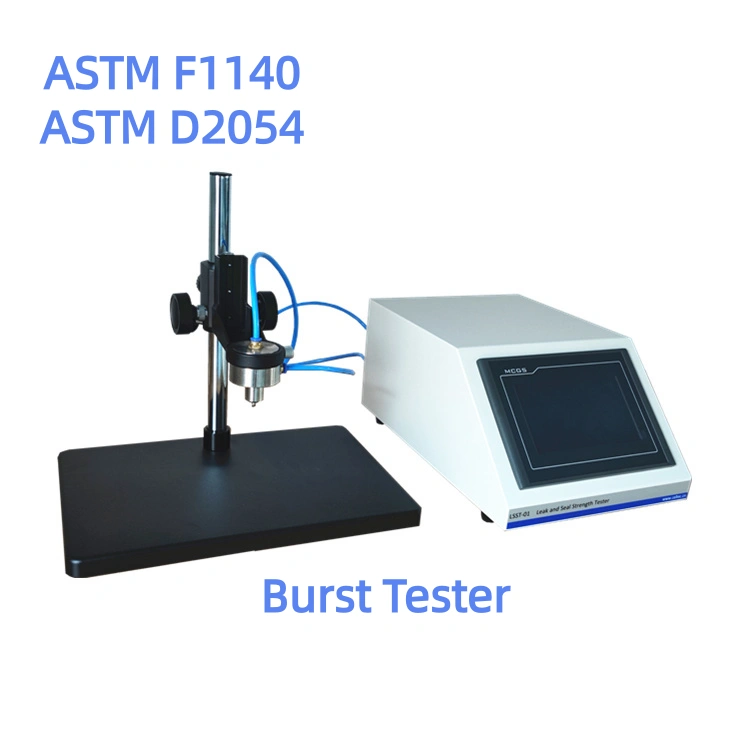
ASTM F2054 is a critical standard for evaluating the burst strength of flexible package seals. It provides a systematic method to measure how packaging withstands internal air pressure while restrained between plates, helping manufacturers ensure package integrity during sterilization, transportation, and storage. Using this standard, quality control teams can identify weaknesses in package seals and improve production consistency.
Bursting Strength Tester Digital: Essential Tool for ASTM F2054
To perform ASTM F2054 tests accurately, a bursting strength tester digital is essential. This device pressurizes packages in a controlled manner until the seal area ruptures, recording the internal pressure at failure. Both open and closed package configurations can be tested:
- Open Package Testing: Involves packages with three sealed sides and one open side. The package is enclosed between restraining plates, and the open end is sealed during the test. The tester ensures that expansion is restricted while the seal perimeter remains unrestrained.
- Closed Package Testing: Designed for fully sealed packages. A puncture allows the pressurization nozzle to inflate the package while maintaining an airtight seal. The internal pressure is monitored until a rupture occurs.
Using a digital burst tester allows precise measurement of failure pressure, reduces human error, and provides reliable data for both in-process and final package evaluation.
Significance and Applications
У "The ASTM F2054 test is widely used to assess the seal integrity of packaging in multiple industries:
- Medical Devices: Sterile pouches, syringes, and blister packs.
- Pharmaceuticals: Foil-sealed bags, sachets, and unit-dose packages.
- Food & Beverage: Flexible pouches and vacuum-sealed bags.
- Consumer Goods: Electronics, cosmetics, and daily chemical packaging.
This test ensures packages meet minimum burst strength requirements, giving manufacturers and end-users confidence in product safety and consistency. It also supports regulatory compliance and helps prevent costly recalls caused by seal failures.
Test Procedure Overview
Package Preparation: Determine if testing will be conducted with or without the product inside. Record all preparation steps for traceability.
Conditioning: Precondition packages according to ASTM E171 for at least 72 hours to ensure consistent results.
Insertion in Tester: Position packages between restraining plates. Insert pressurization and sensor nozzles appropriately for open or closed configurations.
Pressurization: Set desired rate and sensor sensitivity. Gradually increase internal pressure until rupture occurs. Record the burst pressure and visually examine the failure location.
Documentation: Note the type of failure—whether it is material rupture or seal failure. Document all readings and observations for quality assurance.
Advantages of Using Cell Instruments Burst Tester
Cell Instruments offers a burst tester designed for digital precision and repeatability. Key advantages include:
- Accurate pressure measurement and real-time monitoring.
- Compatibility with open and closed package configurations.
- Support for ASTM F2054 compliance, helping streamline QC processes.
- Easy integration into laboratory workflows for rapid, consistent testing.
Conclusion
Adopting ASTM F2054 and using a bursting strength tester digital enables manufacturers to systematically evaluate package seal integrity. It helps ensure compliance, optimize packaging design, and protect end-users. Integrating Cell Instruments’ advanced burst tester into quality control workflows improves accuracy, enhances efficiency, and maintains consistent product safety across all packaging applications.
FAQ
What is ASTM F2054 used for?
It evaluates the burst strength of flexible package seals using internal air pressurization within restraining plates.
What types of packages can be tested?
Both open (three-sided seals) and closed (fully sealed) packages can be tested.
Why use a digital burst tester?
Digital testers provide precise pressure readings, reduce human error, and improve repeatability.
How does ASTM F2054 differ from ASTM F1140?
F2054 focuses on seal testing within restraining plates, while F1140 evaluates overall package burst under unrestrained conditions.
Which industries benefit most from this test?
Medical, pharmaceutical, food, beverage, and consumer goods packaging industries gain the most from ASTM F2054 testing.
 Українська
  English
  العربية
  Български
  Čeština
  Dansk
Dansk  Deutsch
  Ελληνικά
  Español
  Eesti
Eesti  Suomi
Suomi  Français
  Magyar
  Bahasa Indonesia
  Italiano
  日本語
日本語  한국어
한국어  Lietuvių kalba
  Latviešu valoda
  Norsk bokmål
  Nederlands
  Polski
  Português
  Română
  Русский
  Slovenčina
  Slovenščina
  Svenska
  Türkçe